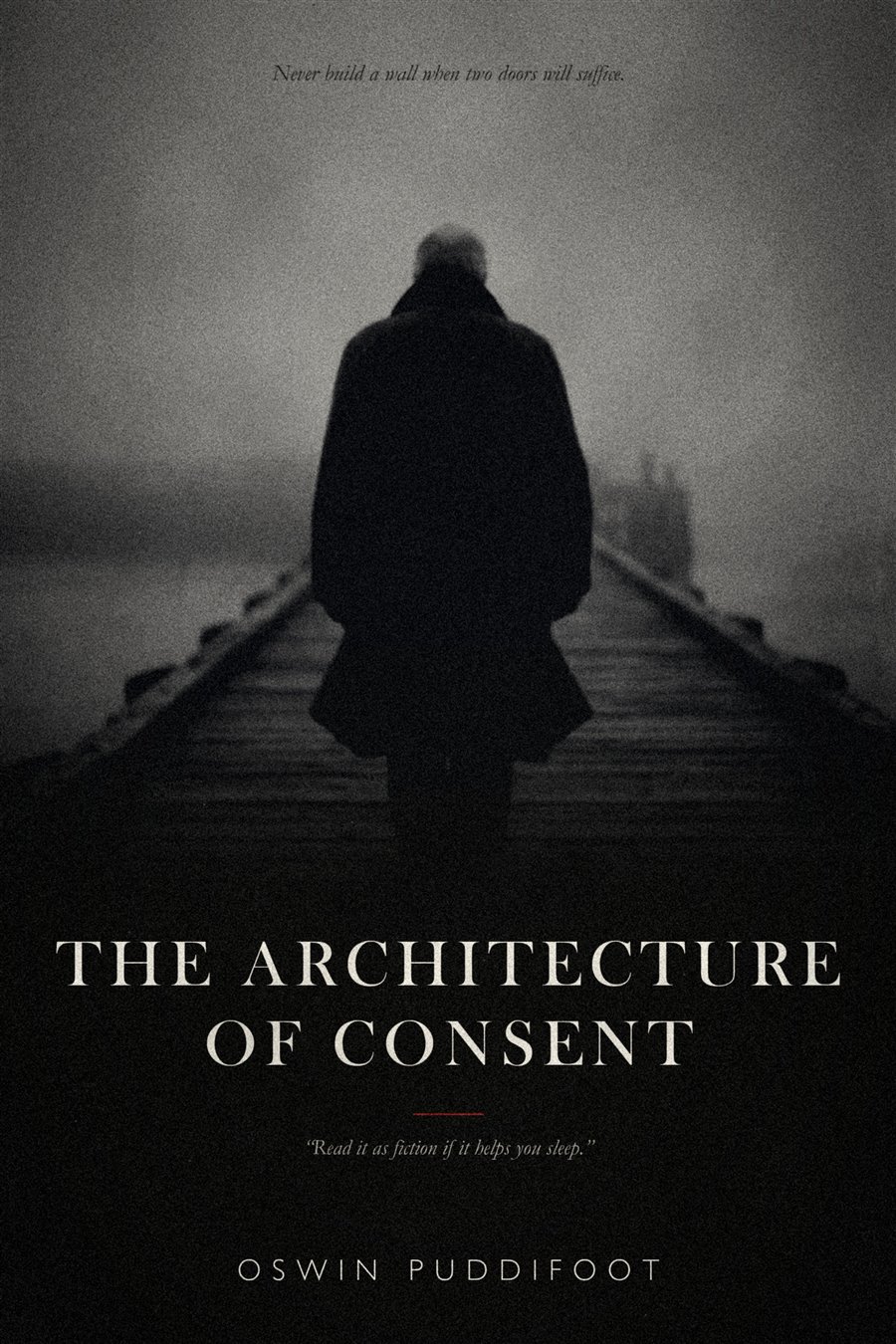
Cover of The Architecture of Consent by Oswin Puddifoot
Classified as speculative fiction

The Architecture of Consent

eBookEPUB + PDF · instant download
$12.99 Buy →
AudiobookThe complete book, read aloud
$3.99 Coming soon
BundleCourse + eBook + Audiobook
$40 Coming soon

Secure checkout by Stripe · Read Protocol 01 first →

01 — The Book

A manual,
disguised as
a novel.

How modern institutions manufacture public opinion, engineer rebellions, and keep populations distracted — without ever needing force.

It does not read like a conspiracy. It reads like an internal training document: dry, exact, and patient. Numbered Protocols. Historical examples that sit uncomfortably close to events you remember.

Its author spent forty-two years keeping the minutes. The organisation he served has one rule it does not break: it may not tell a direct lie in print. So it hides the truth in plain sight. He has used that same loophole to publish its playbook — filed, by agreement, under fiction.

ClassificationSpeculative Fiction
Structure13 Protocols, 4 Series
ComposedOlympia SM9, 2023–25
EditionsThis is his only book

For E.G., who taught me that the minutes are always more honest than the meeting.
And for the man on the fourth floor who chose blue.

02 — Preface

A Note on Classification

From the front matter

THE ARCHITECTURE OF CONSENTPREFACE

You will find this book on the shelf marked Speculative Fiction. That was the agreement, and I want to begin by explaining it, because the agreement is the first lesson and the shelf is the first example.

For forty-two years, from the autumn of 1981 until the spring of 2023, I was employed as an administrator. That is what my pension statements say, and they are correct. I kept records. I ordered paper, booked rooms, arranged for coffee to arrive at eleven and for the windows to be closed before anyone spoke. I took minutes. I took a great many minutes. Over four decades I sat in rooms in Geneva, in London, and in Brussels, and occasionally in rooms in places that will not be named here because the buildings still stand and other people still take minutes in them.

The people in those rooms did not have a name for themselves. Outsiders who have suspected their existence have given them a dozen names, all of them wrong and most of them theatrical. Inside, we referred only to the Ledger, which was both the record and the body that kept it. One worked for the Ledger in the same way that one works for the weather. I was, for most of my career, its Keeper: the person responsible for writing down what was decided, filing it, and ensuring that it could be found again by those entitled to find it and by no one else.

The Ledger has one rule that I have always found touching, in the way that one is touched by the scruples of a very old and very dangerous animal. It does not lie in print. It manipulates, it omits, it arranges, it buries, it distracts, and it quietly lets other people lie on its behalf. But when the Ledger itself commits words to paper, under its own authority, those words must be true. I do not know where this rule came from. Elspeth Garrow, who trained me and who had been Keeper since 1949, told me that it predated her own predecessor and that its origin had been deliberately lost, “so that nobody could ever argue it was only a policy.”

The rule produces a particular habit of mind. If you may not lie, and you nevertheless need to be believed to be saying something other than what you are saying, you must learn to hide the truth in the open. You publish the true figures in a table no one reads. You announce the real decision in the fourth paragraph of a statement about something else. You print the plan and call it a forecast. You print the plan and call it a novel.

I have used their habit against them. Everything in the pages that follow is, to the best of my memory and my notes, true. I have changed the names of people and countries and occasionally the colour of a door. I have not changed the mechanics. The publisher’s lawyer, a pleasant young woman who did not once ask me whether any of it was real, recommended the classification you see on the spine. I agreed at once. She thought I was being cooperative. I was being obedient to an older rule than hers.

You may read this as fiction if it helps you sleep. Many people will. That, too, is a Protocol, and you will find it described in Chapter Four.

A few practical notes before we begin.

First, the book is arranged in the order the Protocols were taught to me, not in the order of their archival classification. Inside the Ledger, Protocol 01 was filed under Series IV, Structural Compliance, because it was considered a mature technique, the sort one is permitted to use only after the foundations are poured. I teach it first because it is the easiest to see once you know to look.

Second, each Protocol is written in the same form: a remembered scene, a set of numbered mechanics, an illustrative case drawn from the files, and a practical observation that you may test against your own newspaper. I have kept this form because it is the form in which I was trained, and because I have found, in old age, that I can no longer think in any other.

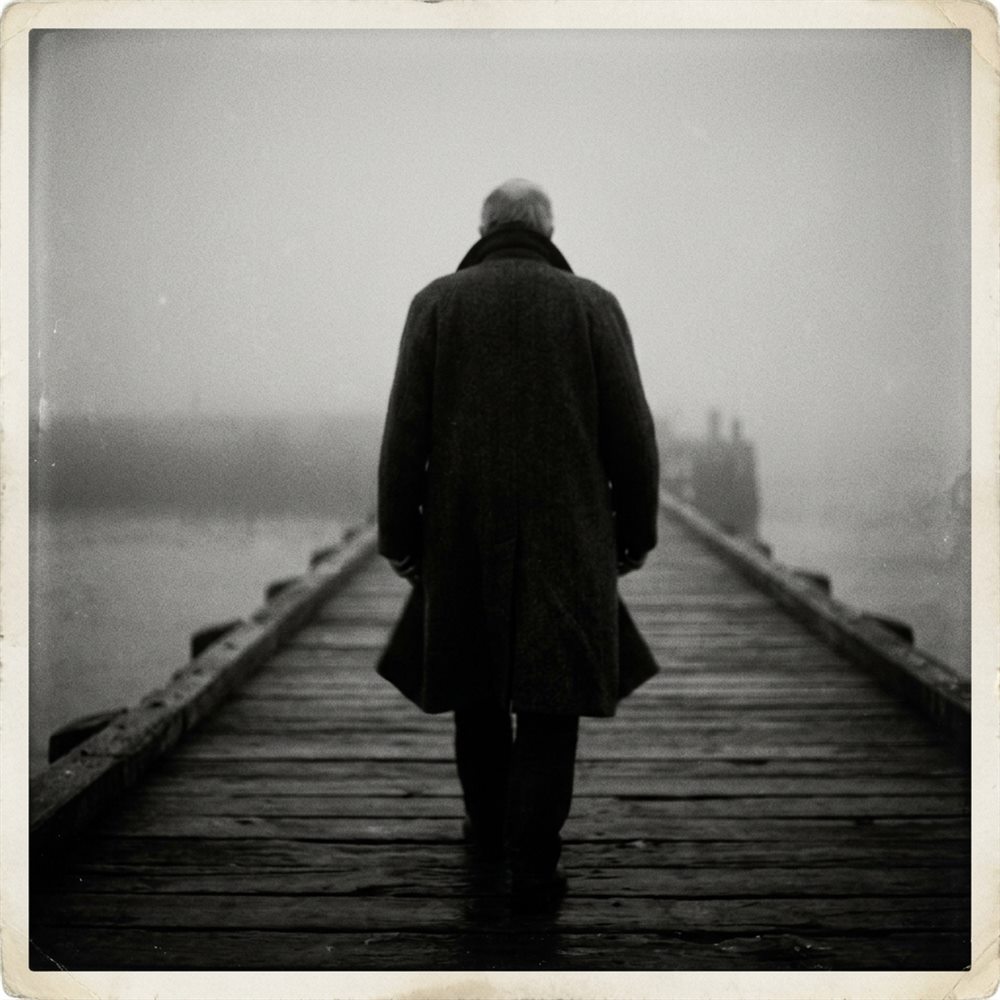
Third, I will not answer letters about this book, and I have no email address at which to ignore you. I live by the sea. I have a typewriter, a kettle, a coal stove, and a tide table. I take the bus into town on Thursdays. If you see a man in a grey wool coat at the end of the pier, please do not photograph him. He is not interesting, and the light is always poor.

O.P.
The North Yorkshire coast
03 — Contents

Thirteen
Protocols.

Each followed by an Interlude
from the signal station.

Front matter
  1. A Note on Classification
Series I — Foundations
  1. 01The Illusion of the CorridorInterlude I · The Typewriter
  2. 02The Street OutsideInterlude II · A Letter to E.G.
  3. 03The Velvet CurtainInterlude III · Tube Seven
  4. 04The Rule of Plain SightInterlude IV · Tuesday
Series II — Economic Continuity
  1. 05The Weather ReportInterlude V · The Bus on Thursday
  2. 06The Small PurseInterlude VI · Seven Letters, Beginning with K
  3. 07The Archive Never ClosesInterlude VII · The Reply
Series III — Managed Dissent
  1. 08The Licensed RebelInterlude VIII · Proofs
  2. 09The Fifty-Fifty EngineInterlude IX · The Harbour Wall
  3. 10The Exhaustion DoctrineInterlude X · Winter
Series IV — Structural Compliance
  1. 11The Benevolent InconvenienceInterlude XI · The Second Courier
  2. 12The Thirteenth LedgerInterlude XII · Publication Day
  3. 13The Terms of Departure
Back matter
  1. Afterword: Who Built the Hallway
04 — Sample Chapter

Protocol 01

Series IV — Structural Compliance

ARCHIVE COPY
SERIES I — FOUNDATIONSPROTOCOL 01

The Illusion of the Corridor

Archival Classification: Series IV — Structural Compliance
Operational Principle: Never build a wall when two doors will suffice.

In the spring of 1986, I sat in a windowless conference room on the fourth floor of an unremarkable office building in Geneva, transcribing a dispute between two senior directors over the colour of a ballot box.

The room was the kind of room I would come to know very well. It had a long table of pale ash, twelve chairs upholstered in a fabric the colour of weak tea, a carafe of water no one drank, and a clock on the wall that had been stopped, on purpose, at twenty past four. Elspeth Garrow had explained the clock to me during my first week. “A clock that runs makes men look at it,” she said, “and a man who looks at a clock is thinking about his train. A stopped clock is furniture.” There was no window because windows are a distraction and also because windows can be looked into. The lighting came from long fluorescent tubes behind frosted panels, and it made everyone in the room look slightly ill, which Elspeth said was also deliberate. “No one performs well under that light. It keeps them honest. Mostly.”

I sat at a small separate desk in the corner, as the Keeper always did, with a stenographer’s pad, two fountain pens, and a pencil in case both pens failed. I was thirty-one years old. I had been in the Ledger’s employ for five years and had been permitted to take the minutes of a full directors’ session only twice before. Elspeth sat beside me that day, officially to observe, in practice to correct my shorthand afterwards with a green pen and a sigh.

One director argued for grey. The other insisted on blue.

The director arguing for grey was the younger of the two, a precise and impatient man I will call Anselm Vey. He was only thirty-five then, though he carried himself like a man ten years older, Swiss-educated, with the very clean hands of someone who had never needed to do anything with them. The director arguing for blue I will not name at all, because in forty-two years I never heard anyone use his name aloud, and it seems impolite to start now. Inside the Ledger he was simply the Elder Director, or, among the clerks, the man with the fountain pen. He had a black Pelikan that he never wrote with. He used it to tap.

Neither man cared about aesthetics. They were discussing a regional referendum scheduled to take place eighteen months later in a country neither of them had visited since university. The referendum concerned the devolution of certain administrative powers from a national government to a provincial assembly. The country was small, prosperous, and orderly, and the matter at stake was, by the standards of that room, modest. But the Ledger does not distinguish between large and small matters in the way that newspapers do. It distinguishes only between matters that have been arranged and matters that have not.

The ballot box question had arisen because a printing and fabrication contract for the referendum materials was, by a chain of ownership that would take a chapter to explain, within the Ledger’s reach. Every physical object the voter would touch on the day had been specified in advance: the paper weight of the ballot, the typeface, the order of the two options, the wording of the instructions, the height of the booth curtain, and the colour of the box into which the folded paper would finally be dropped.

Vey’s argument for grey was procedural. Grey was the colour of previous referendums in that country. Grey was neutral. A change would be noticed, and anything noticed might be questioned.

The Elder Director let him finish. Then he tapped his fountain pen against the blotter, three times, and settled the matter.

“Make it blue,” he said. “Grey feels administrative. Blue feels like a choice.”

I wrote it down. I remember that my pen paused on the word choice, and that Elspeth, without looking at me, moved her own pen an inch closer to my pad, which was her way of telling me to keep going.

Vey objected once more. The change would be noticed, he said.

“Of course it will be noticed,” the Elder Director said. “We want it noticed. They will say the government has made the process feel fresh and modern. They will say it is respectful of the occasion. Someone will write a column about the psychology of colour. Let them. A voter who feels that the state has dressed up for him will believe that the occasion is real.”

“And it isn’t?” Vey said. He was not being naive. He was making the Elder Director say it for the record, and for the young man in the corner with the pad.

“Both outcomes have been costed,” the Elder Director said. “Both are acceptable. The provincial assembly will be granted powers over roads, schools, and the regional broadcaster. The national government will keep currency, customs, defence, and the telecommunications licences. If the vote goes the other way, the provincial assembly will be granted powers over roads and schools, and the regional broadcaster will be reformed by a commission instead. The difference is a matter of furniture. What we cannot afford is for anyone to feel that it is furniture. So: blue.”

The meeting moved on. The colour of the ballot box occupied, in my final minutes, eleven lines. I still have a copy of those lines, though not the original, which is where it belongs.

That single distinction, the difference between feeling managed and feeling free, is the foundation upon which every modern institution rests.

I. The Expense of Walls

Amateur autocrats rely on force. They censor, they imprison, they erect visible barriers. Every generation produces a few of them, and every generation the Ledger watches them with the weary interest that a professional chef might bring to a man setting fire to his own kitchen.

Force has three defects, and Elspeth Garrow made me write them out in longhand, a hundred times, during my first winter. I can still recite them.

Force is expensive. A soldier must be fed, paid, housed, and watched. A prison must be built and staffed. A censor must be employed, and then a second censor must be employed to read what the first censor missed, and then someone must be employed to censor the censors. Every wall requires a guard, and every guard is a salary, a pension, a family, and a potential defector. The Ledger kept careful accounts of such regimes. In one of the files I maintained, a Central European state of the 1970s was spending, by our estimate, a little over eleven per cent of its national product on the apparatus of internal control. It achieved, for this sum, a population that obeyed in public and despised it in private, which is to say a population that would leave the moment the walls came down. And they did.

Force is messy. It produces martyrs, photographs, funerals, songs. It leaves evidence. A beaten protester becomes a symbol; a banned book becomes a sacred text. Force writes its own history in the bodies of its victims, and that history cannot be filed, edited, or misplaced. The Ledger, as you will come to understand, regards the permanent record as its most important asset. It does not like competitors.

Force clarifies the enemy. This is the most serious of the three defects, and the one that most amateur autocrats never understand. When a man sees a soldier standing in front of a locked gate, he knows precisely who is keeping him inside. He may be afraid of the soldier. He may obey the soldier for forty years. But he is never confused. He knows that the gate exists, he knows who built it, and he knows that on the day the soldier looks away, he will walk through it. Clarity is the enemy of continuity. A population that knows who its jailer is will always, eventually, find the key.

Elspeth summarised it in a sentence that I have used, in one form or another, at the beginning of every training session I ever gave: “A wall tells a man where freedom is. Never tell a man where freedom is.”

[ The remainder of this file is held in the book. ]

Acquire a copy →

An elderly man in a wool coat walking away down a foggy wooden pier
The author declines to be photographed.
05 — The Author

Oswin Puddifoot

Oswin Puddifoot spent forty-two years in private institutional administration in Geneva, London, and Brussels before retiring to the coast. This is his only book.

  • Former postInstitutional archivist, Geneva / London / Brussels
  • Service1981 – 2023
  • ResidenceA converted signal station, North Yorkshire coast
  • InstrumentOlympia SM9 typewriter. Fountain pen.
  • TelephoneNone

I do not give interviews.
Read the protocols while they are still in print.

06 — From the Ledger

Notes, typed and sent.

For forty-two years, my job was to sit quietly in rooms in Geneva and Brussels and record how public opinion was going to be shaped over the next five years. I retired in 2023. Then I published the playbook as a ‘novel.’ — O.P.
You do not control a population by locking the doors. You control them by making the hallway outside look terrifying, and letting them lock the doors themselves. Protocol 02
Whenever two famous figures have a loud, public feud over something trivial, check what legislation is quietly passing on page 14 of the financial papers that same week. We called this ‘The Velvet Curtain.’ — O.P.
I have been informed my book has been placed in the ‘Speculative Fiction’ category. That was the agreement. Read it as fiction if it helps you sleep. — O.P.
07 — Acquire

The Architecture of Consent

Everything in the book is legally classified as fiction. Treat it accordingly.

Digital eBook $12.99 USD
  • The complete book
  • All thirteen Protocols
  • Instant download
Acquire →
Audio Audiobook $3.99 USD
  • The complete book, read aloud
  • Listen anywhere
  • Instant download
Coming soon

Secure checkout by Stripe

Read it while it is still in print.